Description
Ready to put this lesson into practice? Check out Lesley Logan's Thass® Connection Playlist.
About This Video
Transcript
Read Full Transcript
Hi, I'm Lesa Logan, and I wanna talk about hip, hip clicking, hip aching, hip pain, not necessarily from an injury standpoint. We could go for hours. In fact, many of the plies anytime teachers could probably do dissertations on the hip. This is more of a basic understanding of, like, you're hearing, hip clicks, or lots of people feeling like their hips are overworking. I understand this completely because when I got into Plies, I was a professional runner, and my quads were so dominant.
And I had a hit click on my left leg, but I actually never felt like my hip flexors were overworking because they were just working so much and they were so strong. However, I would hear teachers say, don't use your hip flexors. Which is a little weird because the way the legs have to move, and also that was kind of impossible for me to understand. And what ended up happening is I had a tibial plateau fracture. And it didn't bother me as long as I didn't hyper extend my knees. Because I was a knee hyper extender and a runner, I had really weak hamstrings and glutes, and I had to go on this whole journey of how do I work the rest of my leg relates to actually be part of the workout. Because as we know in Pilates, Pilates is here to balance our imbalances.
Right? No muscle should be overworked and underworked or underworked. So if we are hearing from clients or maybe you are the person who's feeling your hip flexors are overworking, your hips ache after certain exercises, you only feel them in your hips, or you have that click. It's a sign that we're actually not bringing the rest of the bot the rest of the body to the party. Right? So in pilates, everything has to move from the center So it's not the core. It's the center. The center is the muscles around your front, but also your back and your hips.
And so it's not that I don't want your hip flexors to work. They are part of the band or the chorus, if you will. They're just not a solo singer. They are it's it's literally everyone has to work together. And so I had to in my own journey figure out how do I get my hamstrings and inner thighs and outer hips to come to this party? It's not just It's actually not squeezing your butt. When you're lying down or standing up and you squeeze your butt, that actually causes more of a tuck. Right? When you're sitting on it, you can do that without too much of a problem. But it's about how do we get these all to turn on And then for the teachers watching this without talking about it so much, because you actually can't talk to a person's muscles that don't work.
Their brain and those muscles do not have a relationship yet. They and they just aren't there yet. So I wanna talk about some of the exercise I like to use to build hamstrings, inner thighs, outer hips up so that people can do all these pilates exercise we wanna teach them. We actually really do need to build the bodies up to the exercises. Oftentimes we're bringing the exercises down to the body, and that means oftentimes doing things that dominate with hip flexor movements.
So one of the things I like to use is a magic circle. I actually use this a lot in classes to warm up people's bodies and bring their legs to the center. I also really love the mini magic circle. So if you have access to the mini magic circle, it's really one of the best tools to use for this, but you can do this in any type of class. It can be a reformer class or a a tower class because you can just go lay down on the floor and do it right next to it to start.
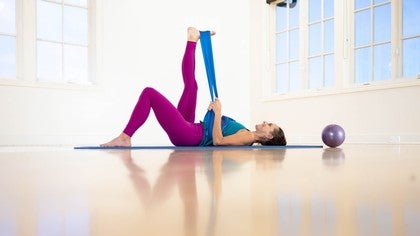
But you wanna put the ankle on the pad of the magic circle, and then take the hand to where their thigh meets their butt. And then they're gonna push down into that circle and lift it up. Now the problem is everyone wants to push down a ton, and then they just bounce around or they push their knee down. So they might actually just think about it, and that's all they get. Right? And so you're gonna push, and I like the hand here because if their brain and the back of their leg don't have a relationship, that kinesthetic touch Your skin is a organ. Right? Can help light up. Oh, these are the muscles, and you can feel them working. So then your brain goes, oh, that's what I wanna turn on. And you can do this on both legs.
Do it on the weaker side My left leg's my weaker side. So I would do that side. Than my right side, than my left side. Then I like to do both legs, because again, we're gonna have people do teasers and hundreds and all elephant, all these exercises where they have to push the legs back and And this helps them understand. It doesn't come from here it comes from here.
And again, it's not that these are not working. It is because we want everything to work. Right? So that's just two on the mat. Some other ones I would do on the mat to help build up my clients strengthen the back of their body is single leg kick and double leg kick. Now a lot of people do a little hip, a little pelvis twerk when they do that.
So you do wanna make sure that you are setting them up for success. They should feel like it's a hamstring curl. But those exercises right there on the mat are really going to help strengthen the seat so that over time, their hip flexors aren't the only thing working. If you are working on a reformer, if I'm working on a contemporary reformer, I actually like to take the foot bar and drop it down a level. If you look at a classical foot arts a little lower, I love to drop it down a level and do footwork on one spring. I have classes, on Plies anytime that talk about this, and we'll link those in the description below.
But that will actually teach you or your clients in class how to move from the back of the leg. When the foot bar's at a lower angle, it gives more acts as a hamstring. The higher the angle, the more it's gonna go into those quads. Right? So it's just something you can do to build up that strength. The other thing I'd make sure I'm doing on the reformer is those hamstring curls. Super important. And when they do hamstring curls, that they're not tensing at the pelvis. Right? We want that tailbone to reach down, so it's really about the hamstrings.
But it's not just strengthening the hamstrings. We also have to stretch it. When you are doing elephant, are they doing elephant from the back of their legs and their center, or are they doing it from their quads? And sometimes people are as feet are too close to the springs to have access to the back of legs for anything other than stretching. So you wanna give some space, work those feet into those shoulder rest. There are so many other exercises we could talk about.
And again, you'll see them in some of the classes that I focus on on strengthening the hip and really getting the hip to be part of the center, but I wanna move over to the tower. And again, these are just warm up exercises. These are these could be homework exercises. Single leg spring with a spring on a across on your tower or springboard is an excellent way to teach the outer hip and hamstring how to work. Also, for you to see what's going on. Because when the spring goes from across, the foot has to work.
The outer hip has to work to keep the foot in line with the hip because the spring's gonna pull it across the midline. Right? So that glute meet is always on. Just gonna give it the strength it needs when it's not using the spring. The other thing is is when that leg goes out and in, you can see How is the person actually straighten their leg? If the leg goes out and it goes up, that's them pushing their knee down to straighten their leg, which tells you they're using quads, hip flexors, and not hamstring? If the leg goes down on the way out, it shows you they're kind of like throwing the leg out there, which eventually means they're gonna hang off that hip flexor. But if the leg goes out and in on the same trajectory on that same line, You're going to be strengthening their hip. So for people who have complained about the front of their hips overworking.
They feel like they're burning. They feel a hip click. It just aches. Some things to do would be to warm up the backs of their body. That comes to the party before the class gets started, before the session gets started, and then give them homework to do at home. And know that it takes time.
It takes time to build our bodies up. And so we wanna make sure, like, when we're putting a class or a session together, What are we doing for the bodies that are there to get them into their center before we challenge it? Right? If we look, even if you don't do the order, just looking at the order that Joe gave us. Everything kind of warms things up, and then it goes a little wild. Right? When you're putting your class or sessions together, how can you warm up the parts of the body that need more of an imitation? Give the weaker sides a little bit more opportunity, and then challenge that to see what we still have to work on. Give it time and be kind. Right? But also remember if people are only coming once a week, we do have to be honest and say, I'm gonna need to do some homework at home. Right? I'm gonna need to do this at home because Pilates We're not here to help them do Pilates better or be the super advanced Pilates person.
We're here to make sure that whatever they do in their life is better. If they're a runner, if they're a pickleball player, if they're a tennis player, if they're A mom chasing after their kids, plus wants to do photography on the side. Like, our goal is not that they are just the most expert Pilates practitioner, and they can do all the choreography. Our goal is that we strengthen their entire center. Leave nothing overworked or under worked, and allow them to do the life that they wanna live without pain aches and balances. And they can have fun, and then they'll always keep coming back. I hope this helps you think a little bit more. And again, we could have talked for three hours. But I also believe that Pilates is best understood by practicing it. So if you look in the class description below, there's several classes of mine where I actually take you from an intermediate level to an advanced level strengthening your hips.
And I hope that you check those out. Ideally in your body, but if you don't have access to the equipment, watching it so you can kinda understand how do these exercises work together to support our entire center. Thank you so much, and have an amazing day.
Tips for Teachers: Working with Contraindications


Mention
 |
Lesley Logan (Teacher) |
 |
Lori M |
Comments



You need to be a subscriber to post a comment.
Please Log In or Create an Account to start your free trial.