Description
About This Video
Transcript
Read Full Transcript
Hi. Thanks for joining me. I'm Meredith, and today we're going to dig a little deeper into the fundamental beginner Pilates repertoire. Keeping in mind, of course, that there is challenge in all levels of the work, and maybe we'll sprinkle in a couple of intermediate things as well. So what I have set up on the reformer is my springs for footwork.
So anywhere from three reds, to three reds in a blue, you can decide what works for you. My preference is three reds in a blue, and we'll just get started. So coming down onto our back, We're gonna rest the feet onto the foot bar and bring the arms down to the sides. Take a moment here and just feel the heaviness of your body or create some heaviness of your body, feeling the natural curves of the spine, the tailbone dropping down into the carriage, the arms pressing down, reaching forward, and we'll begin with a pelvic curl. So there'll be an inhale to prepare. On the exhale, the spine will flatten the feet will press down on the bar and will articulate the body up.
So rolling through the spine. The end of the movement is where the body is in a straight line from the knees down to the shoulders. There's an inhale to pause there, and then we'll start to make our way back down. So the chest drops down. Feel the back of the ribs come down.
Feel the bottom of the ribs come down. Feel the space between the ribs and the pelvis articulate. And finally, we'll reach all the way down into the tailbone. And in here, pressing down into the feet in an effort to feel the backs of the legs engage rolling through the spine. And as you do that, think about the knees reaching forward as the heels are pulling back. All of those ideas are just to create some heat attention to the backs of the legs and roll down.
And as the body is moving through space, we're thinking about using the front of the body to manipulate or move the back of the body through space. Drop all the way down. Inhale. Exhale flatten the spine, press down on the feet, reach forward with the knees and forward with the arms. Keep the inner thighs engaged.
So we are discovering here that even in a simple movement pattern, here we go down, there are many, many things to consider, to think about, to concentrate on. So keep your mind on your body. We'll do two more lifting up, keeping the carriage still. Springs do a lot of work to hold the carriage still here because they're heavy, but See if you can think about keeping the carrots very still and roll down, rounding, hollowing, stretching the spine. Staying equally connected over both feet.
This is the last one lifting up. Thinking about lengthening as you lift, getting the hips nice and high. And lengthening as the spine lowers back down. We'll take some spinal rotation here. Two options One is to just hold the pegs where the straps are connected. The second is to reach down and hold on to the frame. That's my preference, but my shoulders are flexible enough So that's a comfortable position.
If the shoulders are less flexible, holding on to the pegs is probably a better option, lifting one leg, and then the other, the legs are connected together. And we'll take the legs to the right on the inhale. So the upper body here stays very still. We feel the abdominals engaged to pull the legs back to center. And then we go the other way in reaching over.
XL connect. Pull to center. So creating depth by feeling the connection of the center of the body be before we go into our rotation, and then deepening that connection, really pull back into the spine with the abdominals. And inhale reaching across, keeping the knees side by side all the time x sail back to center. And two more to each side, inhale.
Keeping that opposite shoulder blade anchored pulling from the center of the body to come back and inhale over. Dig deep and center last time here, inhale over. Maybe the range will improve with each repetition and back, so think about it as an exploratory action. And inhale over and exhale coming back. I'm gonna place the feet down onto the frame of the reformer now.
Bring the hands behind the head. So I'm kind of wrapping my hands around the shoulder blocks here. We'll inhale to prepare, exhale curl the head and chest up. So just a simple chest lift. Pause at the top to inhale, and then exhale feel that there's work in the body on the way down.
So there's the bare bones of the movement. As you exhale, press the ribs down. Keep the head heavy. Lift yourself up high enough so that you can feel the lower spine imprinting into the carriage and inhale. And as you exhale, feel try to create just as much work on the way down, as you create on the way up and lift up. Of course, the up is muscularly more difficult.
And maybe you can think about the down as being a mental challenge. So feel the work, feel the lengthening contraction in the abdominals. We'll do just two more times lifting up. Heavy head wide elbows imprinting the spine. And elongating the body down. One more time, we'll make a small change at the top, lift up.
Hold here. Take your hands behind your thighs. Use your arms to just reinforce and solidify and maybe even make that shape a little better and then let go. Reach the arms up. Put them back behind the head, and now we'll take rotation. So we go across to one side and back to the center staying lifted.
And up and across. So you could think about center, the opposite rib cage rotating into the opposite side of the pelvis and center. And as you rotate from side to side, feel that the pelvis is very stationary, stable, and center. Not an easy exercise. Keep the eyes just past the thigh that you're rotating towards and center, and up and across.
And challenge yourself as you come through center to try not to drop the body at all last time across and center and up and across. And center, and reach forwards, and place your head down, placing the feet up onto the foot or onto the heels of the feet. To initiate the press with the legs, we wanna push into the heels of the feet and feel the back of the legs turn on. We then move the carriage stretching the springs, going all the way into full extension of the knees, and then pull the carriage in. So we initiate from the backs of the legs, finish with the quadriceps, the fronts of the thighs, straightening the knees, and pull. So we're always thinking in Pilates about working the springs in both directions.
Never letting the springs do our work for us, press. And bend. Other things to consider is that activity in the arms, they're reaching, they're pressing back and in. The abdominals are drawing in towards the carriage and in, and we'll just do three more the same. Reach out and active on the end.
And reach out. And active on the in, and one more time out, and one more time in. Change the feet to come onto the toes. So the feet are parallel to one another on the on the toes and reach out. So the positioning of the feet when the legs are straight is we wanna have the feet in a lifted position, but we wanna have the ankles nice and straight.
And then as the knees bend, the heels stay exactly where they are. And we reach out. So we allow the ankle to do that adjustment so that the heels stay still at and in and abdominals and in. And backs of the legs, hamstrings, and in, and we just create a rhythm. And we bring ourself into the breath exhale to press, inhale to bend, exhale to press, keeping equal weight over both feet last time, exhale to press.
Inhale to bend. Bring the heels together. The knees will open a little just about as wide as the shoulder blades. Same foot position here, stretching out. And then keeping the heels still as you pull the carriage in and reach the legs press all the way together at the top and the heels squeeze together all the time and at.
And rhythm and breath and in, initiating from the backs of the legs, pulling from the backs of the legs to come in, three more. And in two more, keeping the pelvis anchored on both sides, or just nice and steady in the center of the body too. And in and last one, and back. Take the heels to the outside of the foot bar, the knees don't open any wider than they just wore. Just the feet open.
Feel that there's a a drawing together of the feet on the foot bar so that we feel the insides of the legs engage. And from there, we reach out. Just like to lift my head and see how I placed my feet and then put it back down reaching out and in. So we've got inner thighs. Backs of the legs, fronts of the legs, and pull, and reach. Paying attention all the time to where you're initiating the movement from.
Where you're coming back from, where your body is weighted, what your arms are doing. So again, just thinking about all of the different things in the body that we wanna pay attention to. Last four, and in, and rhythm, three, and pull, and breath. And in. One more time.
And back. We'll change from the heels onto the toes in that same wide v position with the legs. And we'll reach out. Here we have those pointed feet, and here we have the heel staying still. And out.
And back. And inner thighs, and in, and upper back and arms. And in. So anytime you feel your mind wander, If you feel your mind wander, you can bring it back. What is the body doing? What is the breath doing?
And five. Pull in. And four. Pull in. An 30 connecting to the center of the body.
And two, and in. Last time. And back. We'll bring the feet back into the center of the bar parallel to the sitting bones on the toes, push the carriage, and lower your heels all the way under that foot bar. And back.
So articulating through the foot and push and pull and reach. And pull, and lift, and down stretching the feet, stretching the backs of the calves, and left will do three more. Keeping the body long in space, keeping the arms active. Last time. And we'll bend one knee and take the other foot down.
Lift and change. So we're one foot's dropping and one foot's pressing into the bar. So we have active feet on both sides. In addition to those ideas, Can we feel that the pelvis stays nice and stable steady as we're changing from one leg to the other? Really reaching as far as you can under the foot bar to maximize that stretch.
Meeting in the middle each time we change sides. And we'll do three and three. Keep both feet active too. And two. And one, pushing into that bent knee foot.
And one, and both feet lift. And we bend the knees. And bring the carriage back in. So we'll roll to the side, help ourselves up, and change the spring. We're gonna go to a red and a blue, or your red and a blue is good.
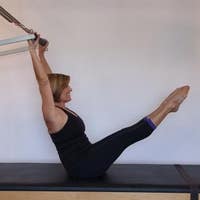
Coming back down. Position your body so there's a little space between your shoulders and the shoulder rest and reach back for the straps. Holding the straps in your hands, establish a straight line from the shoulders up to the hands and then lift the legs up off the bar one at a time, inhale to prepare here. As we exhale, we curl head and chest up reaching out towards the foot bar, lifting up through the chest. Raise the arms up.
And as they pass through about a 90 degree angle, they come with the head as it comes down. And we go. Chest lifts arms pressed. Think not just down, but forward. And then continue to feel the forward energy as arms are lifting up, and then bring the head down the arms and just over the shoulders again. And we go. Head and chest up pressing the legs together, lift the arms and bring the body back and two more head and chest If a red and a blue feels too heavy, this can easily be done on one red instead.
So, of course, do what's best for you, and up. And down that little pause at the top, it's to make it feel more challenging to deepen last one lifts. And down. Keeping the hands in the straps, the legs as they are. The head is down now, and we'll just press straight on with arms.
And up. So our most simple arm series reach down and away. And lift. So the head's not up anymore, but we can still really feel the connection of the arms pressing down to the center of the body. So really think about the abdominals working here.
If this creates any pressure or tension in your lower back, a good strategy is to just bring the knees in a little closer and up and down. And up, holding up. Take the arms out to the side and pull in and out. So again, simple doesn't always mean easy or never really means easy in my mind, for in Pilates and at, pull think about as your arms are opening, you're expanding your breath into your arms. And as your arms are closing, you're pressing the air out of the body and out, and pull, and reach.
And squeeze one more at and in, and then we'll go back at, come over the shoulders, and down. And at. As the arms come from out to up, keep the carriage still and press. So we wanna feel a connection of the muscles underneath the shoulder blades to the hands and the straps That's how we keep the carriage still. That's how we stabilize the shoulders and at up and, and at, up.
And press last two, up, and moving the arms symmetrically, last one, and up, and down. Come up, go out, pull down, reversing the action up, out, and pull. And left continuing to focus on the center of the body and pull and up and at and squeeze reaching the head away from the arms four, at and in. Three, at and pull. Hollowing through the waist, out, and pull the last time up, out, and at the bottom turn the palms face down, bend the arms.
Keep the elbows very close to the body, but just off the reformer, off the carriage, and straighten and bend elbows in close, and straighten and bend and press and bend and press and bend upper back and in, and three, and in, and upper arms stay still too. And in, And one, bring the arms up, place one foot down, the other foot down, and bring the carriage in to close. From here, we'll push out to bring the feet into the straps. Bringing the legs back into that tabletop position and then externally rotating or opening the knees just outside the straps. Pressing the heels together, stretch the legs forward, and pull.
Again, as we push out, the initiation starts from the back of the leg. And we actively pull and reach flexing through the feet and bend and push and bend. And anchoring the sacrum, the tailbone, and bend, and pressing into the arms, and bend, and three and pull actively squeezing the heels together all the time, two, and bend. Last time, reach out point the feet. Bring the legs up just to the point where you feel that your pelvis is very anchored on the carriage, then push down and circle.
Keeping the circles consistent from side to side and just keeping the reformer moving as you go through that circular action in the hips and and around touch and down and around. Nice even circles down and around. And, working from the backs of the legs, and, last one, and around from the top we'll take the reverse out and reach out and down and up. So that idea of not just pulling, but really reaching the legs away, pulling back through the waist, reaching down with the arms, just all reminders again, where we can bring our attention, our energy, and around, stirring the legs and the hips, and around and up and around and down and away and up. Let's just do two more here.
And up. And one more from the bottom. Imagine a straight line on the horizon. The heels will travel along that straight line as they open and travel straight back across and inhale. So the straight line kind of feels like a happy face shape. And down. So it feels like there's a little arc there, but we're just tracing that horizon, wide legs, and pulling back together.
And tracing that straight line, pulling back together. You can work without like a micro bend in the knees and reach out. And pull back in and reach out. And pull back in. We'll do one more.
Inhale. And exhale. We'll bend the knees in. Let your feet separate so the soles of the feet are reaching straight up towards the ceiling. The knees are just on the outside of the body, and you can put your elbows on the insides of your knees.
You can do a little out push with your elbows onto your knees while set the same time doing a little down pull on the straps. We're just taking a stretch here, a happy baby stretch. So we'll bring the legs in. We'll take the feet out one foot at a time, goes down onto the footbar, bend the knees to close the carriage, put the straps back, roll to your side, press yourself up, and we're gonna change springs again. So we're gonna take the blue spring away.
So we have one red spring on the reformer, and then we're gonna come up. Both hands are on the foot bar. The foot on the floor is gonna be just up near the edge of the frame. The foot on the carriage is gonna be in a flexed foot position. Nice and tucked in with the toes.
So we get a stretch in the toes. Bringing the body into an upright position, and then we'll take the carriage back. So just working for a stretch in the front of that hip. You can go nice and low. I'll just pause there to have a couple of breaths.
The leg in the front, the knee is over the ankle, and then we'll take that front leg, flex the foot, and straighten that knee. Just pausing to inhale for a couple of times, exhale for a couple of times. A couple of breaths, full breath cycles. And then bend the knee, put that foot on the floor back down onto the floor. Lift the chest and sink back into that hip flexor stretch, the stretch in the front of the hip.
And then once again, we flex that foot, stretch the leg towards straight. Bend your knee, bring the carriage in, and step off. Come around to the other side. Placing the foot onto the carriage, really get the toes tucked under. That's a little challenging for me, and that's why I take a little bit of extra time.
Making sure that actually happens, lifting the chest up and taking the carriage back. Here, we have a moment to just breathe into the stretch. And then we'll flex that front foot. Keep the body. Keep the spine long as we reach out into the stretch in the back of the leg now.
And then we're gonna bend that front knee, drop back into the stretch in the front of the hip, think about really pressing into the bar with the arms, lifting the spine up and back, pulling the abdominals in. And breathing. And then we'll go flex the foot and lean into the front leg, holding and breathing here as well. I'm bending that knee, lifting the body up, and bringing the carriage in. And come up.
We're gonna keep the same spring. If you want a little bit more stability in the carriage, you could add a yellow or a blue. I'm happy with this spring. We're gonna step onto the reformer. Place the feet back against the shoulder blocks and then lift the pelvis up and lower the body down.
So you want equal weight between your legs and your arms here. The head is just dropped. So it's right in between the upper arms. And from here, we're gonna lift our toes, push back through the heels of the feet. Keep the toes lifted as you pull the carriage back in underneath. The intention here as the legs are moving back and forth is for the back to be very straight.
I don't have a mirror, but I hope I'm giving a good example of that objective. And pull pressing into the heels and reach out and pull in, bringing the carriage in underneath, and two more reach out. And keep the arms active, keep the spine stable, and reach out, and come in. We'll come from there down onto the knees. Once again, getting that flexed foot position, so the toes are very tucked under.
Let's give ourself a little bit more spring. Either a yellow or a blue is appropriate here. I'm gonna do a blue. And then we'll start by just sitting down and back over the heels. So pressing the arms into the bar, begin to lift the pelvis just off the feet as the upper fine round. So you wanna feel that that round comes from around the rib cage rather than really gripping in the pelvis.
So the hips are soft, and then we keep the arms active as we take the legs back and resist the spring. And at an in, an inhale, and exhale, holding the spine just in that stable, long, rounded position, and feeling the emphasis is on the in. The abdominals are stabilizing the position, and we push and pull. And push and pull resist. And at and resist.
And at and resist. Return back to a straight back. Carriage is closed, and then we'll step all the way down and we'll collect our box. So we're gonna do a side over preparatory exercise. And then if you feel brave or your student feels brave, can take it into the full side over.
So we need a box on the short box position We'll just reach through and collect the strap. I'm not you could lower your foot bar if you wanted to. I'm not because I'm gonna use the foot bar in just a minute. So up to you, we're gonna step the foot through the strap and come up onto the side of the hip. We'll take the hand down create a straight line. So as you're creating the straight line, the foot will lift up and press into the strap.
I'm gonna take the up arm straight out of the shoulder. Gonna take the other hand, bring it behind the head, hold for five. Four, three, two, one. Place the hand back down now. You could go back into that same holding pattern or You can go back behind the head and you can lower.
And lift. Keeping the leg active. The heel of the foot pressing up into the strap. And lift out, body stays in a straight line, and left resting anytime you need. Last two.
And lift. Last one. And lift. The hand goes down. We'll come down onto the elbow or you can if you have space in your body to put your hand on the floor, that's also available. And then we'll just take the opposite arm overhead and we'll lean into that stretch, reaching out with the foot and overhead with the arm.
And then use the arms to help us up. And we'll change sides. So that's not technically a beginner exercise, but it's simple enough that I think it's appropriate. Okay. So create that straight line with the body, lift up into the strap with the leg, reach the up arms straight out and bring the other hand behind the head, and we hold five. Hold four.
Hold three. Hold two. Holding the straight line, and then the hand comes down. So, again, the option is to just do that again, or take the body down. And up straight line.
The energy is out, not up, and down, and out. So you create your straight line at the top and down. And out and two, keeping the heel of the foot as your focus and up the leg is parallel and down. And up. So take the hand back down. Again, either to the elbow or down to the ground and reach the arm overhead as you press out with the leg.
This stretch makes the whole thing worth it to me. And then we're gonna come up. Slide the foot out of the strap. Tuck it away and turn the box. So we'll go just to one red spring here, and we'll come down onto the box on the front of the body.
Bring the hands onto the foot bar. And take just a minute here to organize the body. So we've got the legs reaching out. Not relaxing, but not really lifting much higher than the height of the box. And the hands are on the foot part.
And what we're gonna do is we're gonna feel the hands pushing into the foot part without moving the carriage yet to connect into the muscles in the back. And we're gonna move the carriage with those back muscles. So reach out. And pull back in, and reach press. Think about the back of the body doing the work rather than just pushing from the hands.
And energy. The shoulder blades are gliding down the back as we reach out to straight arms. And then I like the sensation of pulling apart on the bar, widening, feeling those mid back muscles working and push. And pull. And one more the same push and in. And this time as we press out, we'll reach up in the body.
And then bend the arms to bring the body down. And same intention. The upper back works as we lift up and bend back in. And lift up. Just reaches forward and up and bend back in.
We'll repeat that twice more lifting. Feeling the connection to the upper back and in and reach up and in. And then we'll just take the hands off of the footbar, press into the box, lift yourself up, and just sit back resting the forearms down on the bar and just pausing here, allowing for the back to feel a stretch, taking an inhale, letting the pelvis get heavy, and an exhale. Another inhale and another exhale. And then we'll remove the hands from the foot bar.
We'll step down off the box. And we're done. Thank you for joining me.
Pilates with Meri Rogers: Reformer Workouts


Comments








You need to be a subscriber to post a comment.
Please Log In or Create an Account to start your free trial.